ORIGAMI SIMULATOR
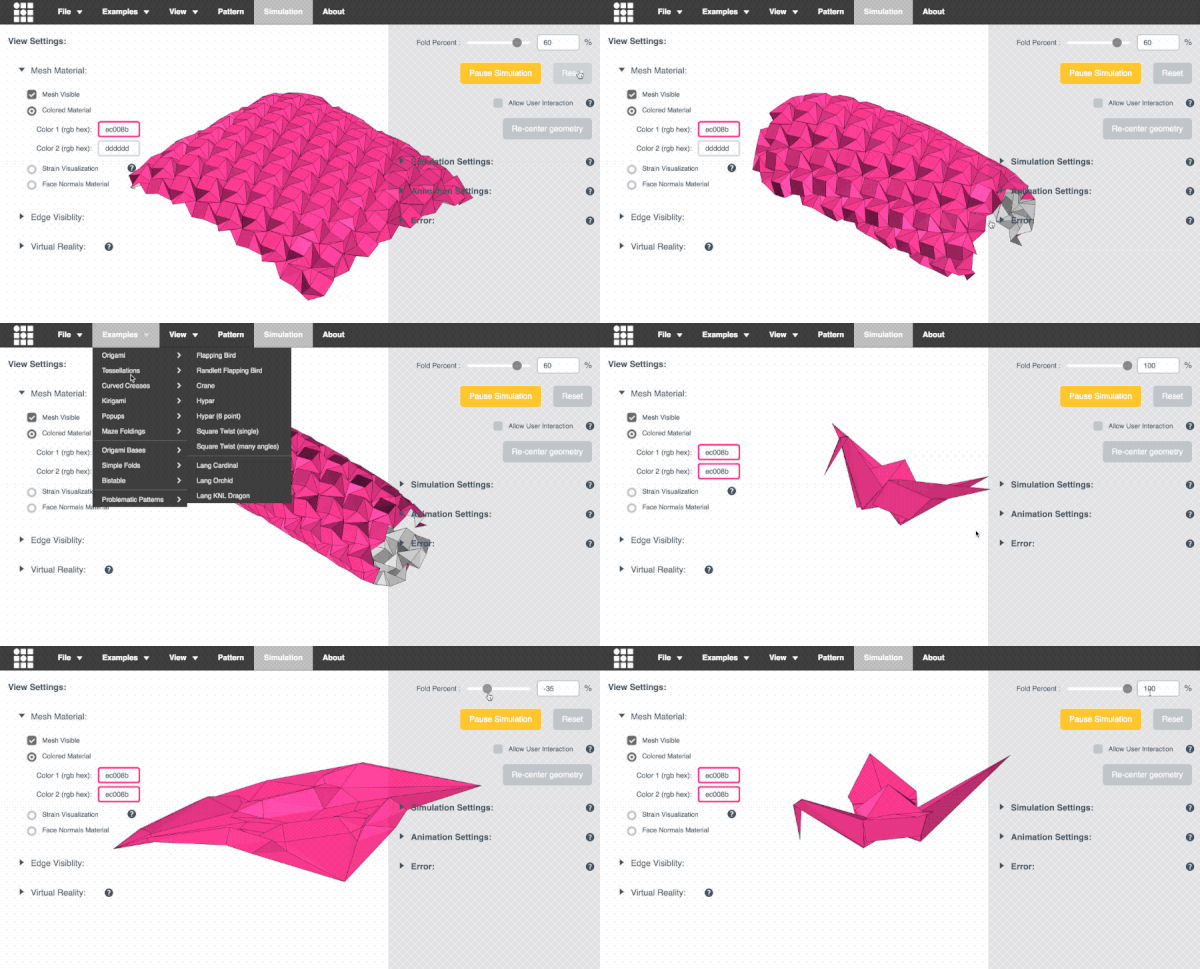
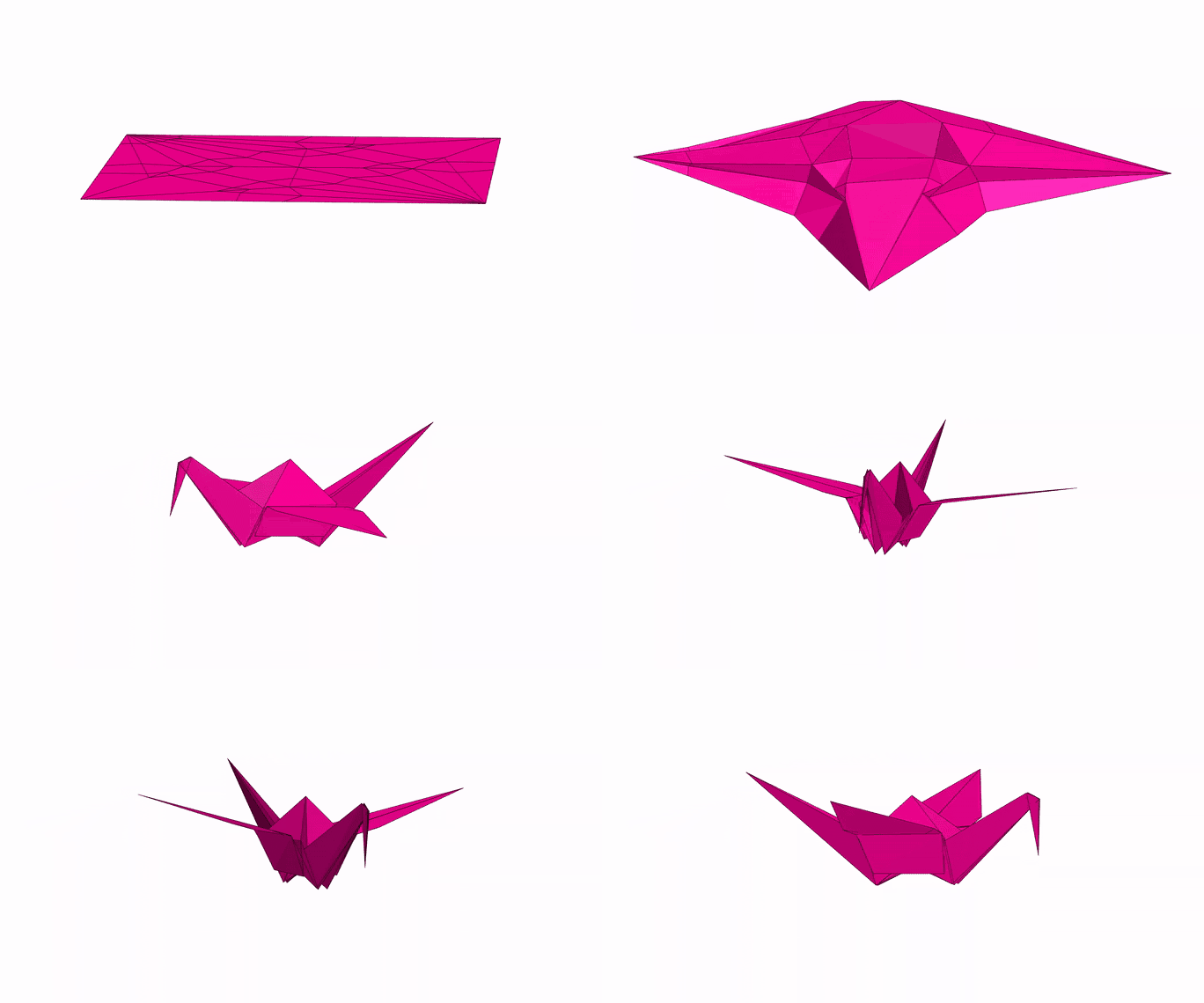
This app allows you to simulate how any origami crease pattern will fold. It may look a little different
from what you typically think of as "origami" - rather than folding paper in a set of sequential steps,
this simulation attempts to fold every crease simultaneously. It does this by iteratively solving for small displacements in the geometry of an initially flat sheet due to forces
exerted by creases.
You can read more about it in our paper:
This app also uses the methods described in Simple Simulation of Curved Folds Based on Ruling-aware Triangulation to import curved crease patterns and pre-process them in a way that realistically simulates the bending between the creases. urgenze ed emergenze chiaranda
Originally built by Amanda Ghassaei as a final project for Geometric Folding Algorithms.
Other contributors include Sasaki Kosuke, Erik Demaine, and others.
Code available on Github. If you have interesting crease patterns that would
make good demo files, please send them to me (Amanda) so I can add them to the Examples menu. My email address is on my website. Thanks!
However, a contemporary reading of Chiaranda must also


You can find additional information in our 7OSME paper and project website.
If you have feedback about features you want to see in this app, please see this thread.
Burnout among emergency physicians, long waiting times, and

However, a contemporary reading of Chiaranda must also acknowledge its limitations. The textbook, for all its clarity, exists within a strained system. The ideal scenario it describes—where an emergency is met with a fully staffed team, a free CT scanner, and a nearby ICU bed—is increasingly rare. Burnout among emergency physicians, long waiting times, and resource shortages mean that the "Chiaranda method" is often practiced under duress. Yet, this only elevates the text’s importance. When the system fails, the algorithm remains. When technology is unavailable, clinical reasoning (the core of Chiaranda) becomes the only tool.
Furthermore, the text implicitly critiques a modern paradox: the over-medicalization of minor urgencies and the under-recognition of true emergencies. In Italy, as in many nations, patients often flood the Pronto Soccorso with non-urgent complaints—a cold, a mild sprain—while a silent myocardial infarction waits unnoticed in the corner. Chiaranda’s systematic methodology trains the physician to resist the noise and focus on the signal. It is a form of intellectual triage, distinguishing the red flags (dyspnea, chest pain, altered mental status) from the false alarms.
What makes Urgenze ed Emergenze an enduring masterpiece is its refusal to separate technical skill from humanistic reasoning. The text is famous for its decision-making algorithms, its "ABCDE" approach (Airway, Breathing, Circulation, Disability, Exposure), and its meticulous lists of differential diagnoses. Yet, woven into every chapter is the subtle reminder that the patient is not a puzzle to be solved but a person to be stabilized. Chiaranda teaches that the first drug to administer is not epinephrine or amiodarone, but —the calm, authoritative recognition of suffering. In an era of defensive medicine and overflowing emergency departments, the book advocates for what might be called "measured urgency": doing everything necessary, but nothing superfluous.
In conclusion, Urgenze ed Emergenze Chiaranda is far more than a reference book. It is a training manual for the soul of acute medicine. It teaches that the difference between an urgency and an emergency is not just a matter of minutes, but of wisdom. It reminds us that at the threshold of every critical event, the clinician must hold two opposing truths in balance: the speed of a sprinter and the stillness of a monk. For anyone who has ever stood at the bedside of a crashing patient, the name "Chiaranda" is not an author—it is a compass. And in the storm of emergencies, a compass is worth more than a thousand maps.
In the chaotic symphony of an emergency room—where alarms beep in dissonance, stretchers squeak down linoleum corridors, and the air smells of antiseptic and anxiety—there exists a silent anchor. For generations of Italian physicians and medical students, that anchor has been the textbook Urgenze ed Emergenze by Prof. Ugo Chiaranda. More than a mere collection of protocols, the "Chiaranda" represents a philosophical approach to acute care: a disciplined, compassionate, and systematic method for navigating the narrow bridge between what is urgent and what is an emergency.
The genius of Chiaranda’s work lies first in its foundational distinction between two terms often used interchangeably but which demand radically different responses. An (emergenza) is a critical, life-threatening condition requiring immediate, often invasive, intervention. It is the cardiac arrest, the tension pneumothorax, the anaphylactic shock—a race against biological time. An urgency (urgenza), conversely, is a condition that requires rapid attention (within hours) but does not immediately jeopardize life. It is the displaced fracture, the high fever in a child, the severe migraine. While the layperson sees only a crowded waiting room, the Chiaranda-trained clinician sees a triage of logic: emergencies demand action now ; urgencies demand a plan soon .
VIRTUAL REALITY
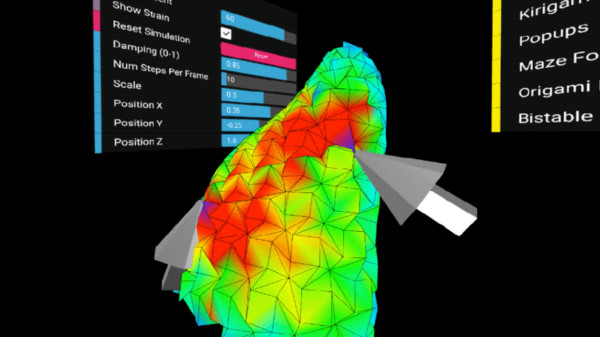
This tool currently supports an interactive Virtual Reality mode for the Vive and Oculus headset and controllers (it may work on others, but it is not tested).
For this to work, you must first use a WebVR enabled browser:
currently only an experimental build of Chromium (with enable-webvr and
-enable-gamepad-extensions flags) and the latest Firefox for Windows
are supported by this app.
When you open this page with the appropriate browser, you will see a button that says "ENTER VR". Clicking this will
put the app into an interactive VR mode. The hand controllers will allow you to grab the origami mesh and pull on it.
This is especially interesting if you set the Mesh Material to Strain Visualization so you can see how your interactions
change the internal strains in the material.
Troubleshooting:
ANIMATION SETTINGS
The dynamic simulation is calculated by solving for all the forces in the system, moving time forward in small Δt steps,
and updating the vertices of the origami incrementally. The time step size for this animation is calculated automatically
based on the material stiffnesses set in the Simulation Settings section: more stiff settings
require shorter time steps to solve and will slow down the simulation.
Num simulation steps per frame allows you to control the number of tiny time steps forward to take on each
render cycle. If the simulation looks choppy to you, you might consider lowering this setting.
Lowering the number of steps per frame will slow down the simulation, but will result in a more smooth animation.
SIMULATION ERROR
Average vertex error gives a sense of how much the distance constraints in the
origami pattern are being violated (i.e. how much the sheet is being stretched). The error at each vertex is evaluated by averaging the
percent deviation of all its distance constraints with adjacent vertices. This error is
reported as a percent of the total length of the distance constraint to remove scaling effects.
This measurement is equivalent to
Cauchy strain or engineering strain of the distance constraints on this system.
Increasing the Axial Stiffness will tighten these constraints and
lower the error in the simulation.
To visualize the error of each vertex graphically, select Strain Visualization under Mesh Material
in the left menu.
SIMULATION SETTINGS
This app uses a compliant dynamic simulation method to solve for the geometry of an origami pattern
at a given fold angle. The simulation sets up several types of constraints: distance constraints prevent the
sheet from stretching or compressing, face constraints prevent the sheet from shearing, and angular constraints fold or flatten the sheet. Each of these constraints is weighted by a stiffness - the stiffer the constraint, the better it is enforced
in the simulation.
Axial Stiffness is the stiffness of the distance constraints. Increasing axial
stiffness will decrease the stretching/compression (strain) in the simulation, but it will also slow down the solver.
Face Stiffness is the stiffness of the face constraints, which help the axial constraints prevent deformation of the sheet's surface between the creases.
Fold and facet stiffnesses correspond to two types of angular constraints. Fold Stiffness is the stiffness of the mountain
and valley creases in the origami pattern. Facet Stiffness is the stiffness of the triangulated faces between
creases in the pattern. Increasing facet stiffness causes the faces between creases to stay very flat as the origami is folded.
As facet stiffness becomes very high, this simulation approaches a
rigid origami simulation, and models the behavior of a rigid material (such as metal) when folded.
Internally, constraint stiffnesses are scaled by the length of the edge associated with that constraint to determine its geometric stiffness. For Axial constaints, stiffness is
divided by length and for angular constraints, stiffness is multiplied by length.
Since this is a dynamic simulation, vertices of the origami move with some notion of acceleration and velocity. In order to
keep the system stable and help it converge to a static solution,
damping is applied to slow the motion of the vertices. The Damping slider allows you to control the amount of damping
present in the simulation. Decreasing damping makes the simulation more "springy".
It may be useful to temporarily turn down damping to help the simulation more quickly converge towards its static solution - especially
for patterns that take a long time to curl.
A Numerical Integration technique is used to integrate acceleration into velocity and position for each time step of the simulation.
Different integration techniques have different associated computational cost, error, and stability. This app allows you to choose
between two different integration techniques: Euler Integration
is the simplest type of numerical integration (first order) with large associated error, and
Verlet Integration is a second order integration technique
with lower error and better stability than Euler.
COMPLIANT DYNAMIC SIMULATION
....
COMPLIANT STATIC SIMULATION
....
RIGID STATIC SIMULATION
....
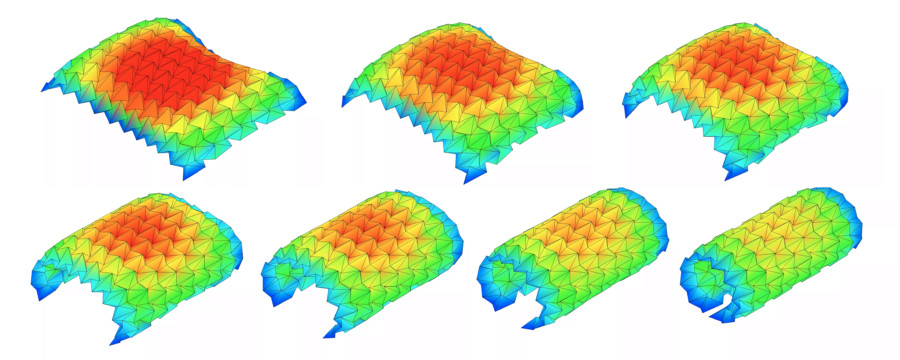
STRAIN VISUALIZATION
Cauchy strain or engineering strain is a unitless measurement of how much a material is being stretched or compressed under load.
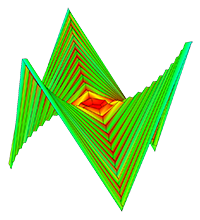
The Strain Visualization illustrates the strain across an origami sheet by mapping it to a color from blue (no strain) to red (max strain).
USER INTERACTION
Toggle this control to enable/disable mouse interaction with the origami model. When enabled,
mousing over the model will display a highlighter; clicking and dragging allows you to
interact with the model in real time. Very vigorous interactions with the model may cause it
to pop into a strange configuration that it can't escape - use the Reset button to start
the simulation again from a flat state.
ROTATION SPEED
Speed : ( radians per frame )
BACKGROUND COLOR
Color (rgb hex) :
Hex colors are 6 digit alphanumeric codes that specify different colors. You can get these codes using a color picker.
SVG IMPORT SETTINGS
Vertex merge tolerance (px) :
For curved folding
Intervals of vertices for discretization (px) :
Approximation tolerance of curves (px) :
However, a contemporary reading of Chiaranda must also acknowledge its limitations. The textbook, for all its clarity, exists within a strained system. The ideal scenario it describes—where an emergency is met with a fully staffed team, a free CT scanner, and a nearby ICU bed—is increasingly rare. Burnout among emergency physicians, long waiting times, and resource shortages mean that the "Chiaranda method" is often practiced under duress. Yet, this only elevates the text’s importance. When the system fails, the algorithm remains. When technology is unavailable, clinical reasoning (the core of Chiaranda) becomes the only tool.

Furthermore, the text implicitly critiques a modern paradox: the over-medicalization of minor urgencies and the under-recognition of true emergencies. In Italy, as in many nations, patients often flood the Pronto Soccorso with non-urgent complaints—a cold, a mild sprain—while a silent myocardial infarction waits unnoticed in the corner. Chiaranda’s systematic methodology trains the physician to resist the noise and focus on the signal. It is a form of intellectual triage, distinguishing the red flags (dyspnea, chest pain, altered mental status) from the false alarms.
What makes Urgenze ed Emergenze an enduring masterpiece is its refusal to separate technical skill from humanistic reasoning. The text is famous for its decision-making algorithms, its "ABCDE" approach (Airway, Breathing, Circulation, Disability, Exposure), and its meticulous lists of differential diagnoses. Yet, woven into every chapter is the subtle reminder that the patient is not a puzzle to be solved but a person to be stabilized. Chiaranda teaches that the first drug to administer is not epinephrine or amiodarone, but —the calm, authoritative recognition of suffering. In an era of defensive medicine and overflowing emergency departments, the book advocates for what might be called "measured urgency": doing everything necessary, but nothing superfluous.
In conclusion, Urgenze ed Emergenze Chiaranda is far more than a reference book. It is a training manual for the soul of acute medicine. It teaches that the difference between an urgency and an emergency is not just a matter of minutes, but of wisdom. It reminds us that at the threshold of every critical event, the clinician must hold two opposing truths in balance: the speed of a sprinter and the stillness of a monk. For anyone who has ever stood at the bedside of a crashing patient, the name "Chiaranda" is not an author—it is a compass. And in the storm of emergencies, a compass is worth more than a thousand maps.
In the chaotic symphony of an emergency room—where alarms beep in dissonance, stretchers squeak down linoleum corridors, and the air smells of antiseptic and anxiety—there exists a silent anchor. For generations of Italian physicians and medical students, that anchor has been the textbook Urgenze ed Emergenze by Prof. Ugo Chiaranda. More than a mere collection of protocols, the "Chiaranda" represents a philosophical approach to acute care: a disciplined, compassionate, and systematic method for navigating the narrow bridge between what is urgent and what is an emergency.
The genius of Chiaranda’s work lies first in its foundational distinction between two terms often used interchangeably but which demand radically different responses. An (emergenza) is a critical, life-threatening condition requiring immediate, often invasive, intervention. It is the cardiac arrest, the tension pneumothorax, the anaphylactic shock—a race against biological time. An urgency (urgenza), conversely, is a condition that requires rapid attention (within hours) but does not immediately jeopardize life. It is the displaced fracture, the high fever in a child, the severe migraine. While the layperson sees only a crowded waiting room, the Chiaranda-trained clinician sees a triage of logic: emergencies demand action now ; urgencies demand a plan soon .